The Enigmatic Universe of Star Maze Puzzles: Design, Engagement, and Cognitive Benefits
In the vast landscape of puzzle books and cognitive games, a particular genre stands out for its visual allure and mental challenge: star maze puzzles. These intricate designs, often featuring interconnecting lines and celestial-inspired nodes, offer a unique twist on traditional pathfinding activities. Unlike simple grid-based mazes, star mazes utilize radial symmetry, branching pathways, and geometric complexity to create puzzles that are both aesthetically pleasing and intellectually demanding.
Anatomy of a Star Maze: Understanding the Core Structure
A star maze is fundamentally a network puzzle. The core visual element is typically a central point or shape, from which multiple arms or pathways radiate outward. These pathways intersect, loop, and terminate, creating a web of possible routes. The solver's objective is usually to find the correct continuous path from a designated start point, often on the periphery, to a goal point, which might be at the center or another outer node. The pathways are not always linear; they can curve, form partial circles, or create closed loops that must be navigated around.
The design principle hinges on controlled complexity. A well-crafted star maze presents a clear visual hierarchy so the solver isn't overwhelmed by clutter, yet embeds sufficient false branches and dead ends to provide a genuine challenge. The "star" motif allows for natural symmetry, which can be used to create patterns that are predictable in form but unpredictable in solution, playing with the solver's spatial reasoning expectations.
From Digital Creation to Physical Pages: The KDP Interior Process
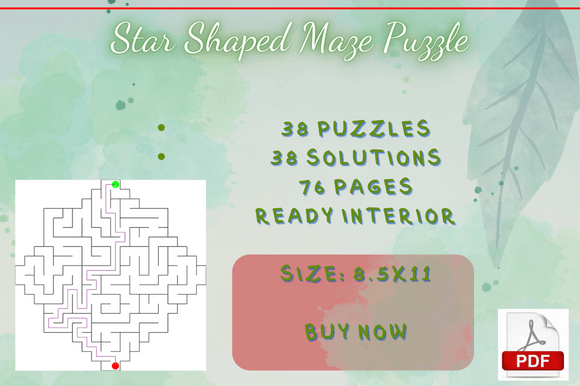
The journey of a star maze puzzle from concept to a finished product like the 38 Star Maze with Solutions KDP Interior involves specific design workflows. Creators begin with digital illustration software, sketching the radial framework. Each maze must be individually crafted to ensure variety; no two puzzles should feel identical. Considerations include difficulty progression, visual distinctiveness, and the logical consistency of the solution path.
For a KDP (Kindle Direct Publishing) interior ready for upload, technical precision is key. The standard 8.5"x11" format provides ample space for a single, large maze per page, ensuring the user has a clear, uncluttered solving area. The inclusion of a solutions section, typically in a separate part of the PDF or on alternate pages, is crucial for user satisfaction and self-guided learning. The final deliverables—one PDF file and often a cover PNG—are optimized for print-on-demand quality, where line sharpness and contrast are essential for readability.
The Cognitive Journey: What Solving Star Mazes Engages
Engaging with star maze puzzles is not merely a pastime; it activates several cognitive domains. Primarily, it challenges visual-spatial processing. The solver must perceive relationships between distant points on the page, track pathways against a background of similar lines, and mentally rotate and traverse the radial layout. This strengthens skills analogous to those used in navigation, technical diagram reading, and even certain types of abstract mathematical thinking.
Secondly, these puzzles demand sustained attention and inhibitory control. The brain must focus on the correct path while actively ignoring the numerous tempting but incorrect branches. This exercises the mind's ability to maintain focus and suppress irrelevant information, a skill transferable to tasks requiring concentration in noisy environments or complex problem-solving. Furthermore, the successful completion of a maze provides a micro-dose of achievement, reinforcing persistence and reward-linked learning cycles.
Diverse Audiences and Practical Applications
The appeal of a star maze puzzle book cuts across a broad demographic. For hobbyists and puzzle enthusiasts, it offers a fresh variation from standard mazes and crosswords, adding a collection of visually striking challenges to their repertoire. Educators, particularly those in fields teaching logic, geometry, or basic computer science concepts, can utilize these puzzles as tangible exercises in graph theory and pathfinding algorithms. The non-verbal, logic-based nature of the task makes it accessible and beneficial for a wide age range.
Professionals in design and UX fields might analyze the structure of star mazes as case studies in user flow and visual hierarchy, where the "user" (the solver) must find an efficient path through a complex system. Even for casual consumers, such puzzle books serve as effective tools for mental relaxation that is active rather than passive, providing a meditative focus that can reduce stress by channeling cognitive energy into a single, manageable task.
Characteristics of a High-Quality Star Maze Collection
A premium product like an interior featuring 38 star maze puzzles is defined by several key attributes. First is variety. The collection should present mazes of differing complexity, from simpler designs suitable for warm-up or younger solvers to intensely complex networks that challenge even experienced puzzle fans. The visual themes might vary—some stars might be angular and sharp, others soft and curved—while maintaining the core radial identity.
Second is clarity of presentation. Each maze must be printed with high-resolution lines, distinct start and end markers, and a background free from distracting elements. The companion solutions should be equally clear, often presented on a separate page or in a condensed section, allowing the solver to verify their path without confusion. Third is structural integrity for the physical book. A 76-page interior, with one maze per page and solutions included, offers a substantial yet non-overwhelming volume, providing a sense of completion and value.
Balancing Challenge and Accessibility in Design
Creating a star maze that is challenging but not frustrating is a design art. The puzzle designer must avoid arbitrary complexity. A good maze feels "solvable"; its logic, while hidden, follows a consistent internal rule set. The dead ends should feel like plausible alternatives, not random traps. The use of symmetry can be a tool here: a solver might learn to anticipate patterns, only to have the solution break that pattern in a fair but surprising way. This balance ensures that the experience is engaging rather than discouraging, promoting a sense of learning and pattern recognition over time.
Observations from seasoned puzzle creators suggest that incorporating slight thematic variations—like a "starburst" maze versus a "constellation" maze—helps maintain user interest across the entire collection. It prevents the monotony that can arise from solving dozens of puzzles with the exact same visual template.
The Role of Solutions and Self-Guided Learning
Including solutions, as in the described KDP Interior Star Mazes Puzzle Book, transforms the product from a mere activity book into a tool for self-guided learning. The presence of solutions allows the user to independently verify their work, learn from mistakes, and analyze alternative pathways they might have missed. This feedback loop is critical for cognitive development. It enables the solver to compare their chosen path against the optimal path, often revealing shortcuts or logical oversights.
For some users, the solutions section serves as a teaching aid. They might attempt a maze, find themselves stuck, and then study the solution to understand the underlying logic, applying that learned logic to subsequent puzzles. This process mirrors skill acquisition in many fields: attempt, fail, analyze correct method, re-attempt with new understanding.
Real-World Relevance Beyond the Page
The skills honed by navigating star mazes have subtle parallels in professional and everyday contexts. The ability to trace a path through a complex network directly relates to understanding flowcharts, circuit diagrams, or transportation maps. The inhibitory control practiced—ignoring false branches—is akin to filtering out irrelevant data in a research report or dismissing non-viable options in a business strategy session.
Moreover, the spatial reasoning involved is foundational for fields like architecture, engineering, and graphic design. While a star maze is an abstract exercise, the mental framework it builds—understanding how parts connect within a whole system—is deeply practical. For researchers studying cognitive decline or rehabilitation, such puzzles can serve as measurable, scalable tasks for assessing or training visual attention and problem-solving speed.
In essence, a well-crafted collection of star maze puzzles is more than a book of games. It is a curated experience that blends artistic design with cognitive science, offering a scalable challenge that can adapt to the user's growing skill. It provides a tangible product for creators via platforms like KDP, and a versatile tool for educators, hobbyists, and professionals seeking to engage their minds in a structured, visually stimulating way. The enduring appeal lies in that combination: the beauty of the star-shaped pattern and the satisfying click of logic when the correct path, once hidden, is finally revealed and traversed.