Exploring the Underwater Challenge: Diver to Mermaid Mazes – 100 Mazes - 5x5
Within the vast ocean of puzzle books and activity sheets, a specific genre offers a unique blend of thematic engagement and cognitive exercise. The concept of mazes, a timeless challenge of pathfinding and logic, finds a delightful new setting in the aquatic world. One prominent example is the collection titled Diver to Mermaid Mazes – 100 Mazes - 5x5. This product represents a focused iteration of maze design, tailored for accessibility and thematic consistency, providing a distinct experience from larger, more complex grids.
Core Characteristics of the 5x5 Maze Format
The primary defining feature of this collection is its grid size. Each maze within Diver to Mermaid Mazes – 100 Mazes is constructed on a 5 by 5 unit framework. This compact format creates a fundamentally different challenge profile compared to the more common 10x10 mazes referenced in the product description. The smaller scale does not merely reduce the quantity of walls or pathways; it alters the puzzle's psychology and pacing.
A 5x5 maze inherently limits the maximum possible path length and complexity. This makes individual puzzles quicker to solve, reducing the potential for frustration and maintaining a brisk pace of achievement. The description accurately notes that "some are terribly easy and some are rather long," indicating that within the constraints of the 5x5 grid, designers have employed clever twists, loops, and deceptive dead-ends to create varying levels of difficulty. The "long" ones here refer to perceptual length—the feeling of a winding journey within a confined space, rather than physical sprawl.
Practical Advantages for Diverse Users
The choice of a 5x5 inch physical size, coupled with a high 300 DPI resolution for clarity, translates to several practical advantages. For young children, often the primary audience for maze activities, the smaller grid is less intimidating. It presents a manageable problem that fits within their developing spatial reasoning capabilities. The clear lines and high print quality prevent visual confusion, which is crucial for early learners.
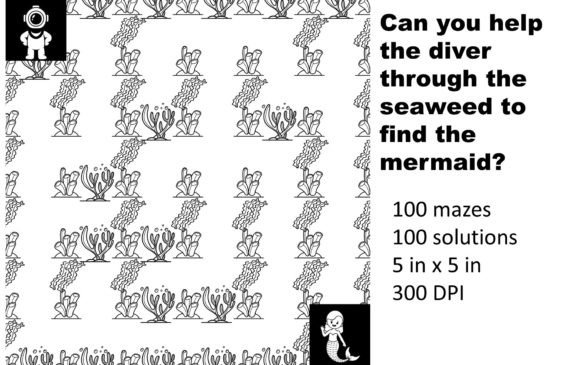
For educators, as mentioned, these mazes are perfect for a class learning about the ocean. Their thematic consistency—every puzzle involves guiding a diver through seaweed to find a mermaid—supports unit-based learning. A teacher can use these as a fun, quiet activity that reinforces an oceanic theme without requiring extensive instruction. The quick solve time allows for their use as short fillers, rewards, or group activities without consuming a full lesson period.
For adults and hobbyists, including "old maze gamers," the appeal lies in the collection's volume and variety. With 100 unique mazes, it offers substantial content. Solving a smaller maze can be a satisfying mental palate cleanser, a brief distraction that exercises logic without the commitment of a sprawling puzzle. It’s akin to a short sudoku versus a complex crossword; both are valid puzzles serving different needs.
Thematic Integration and Creative Origins
The unwavering theme of Diver to Mermaid Mazes – 100 Mazes - 5x5 is not incidental. It provides cohesive context that elevates the activity beyond abstract line navigation. Every puzzle is a miniature story: a diver seeks a mermaid, obstructed by seaweed. This narrative frame can spark imagination in children, suggesting an underwater adventure with each page. For a book about the ocean, such mazes are ideal supplementary material, adding interactive elements that align perfectly with the subject matter.
The origin of the visual assets, as disclosed, is Creative Fabrica. This platform is a known resource for digital creators, offering fonts, graphics, and craft designs. Acknowledging the source of the images underscores the modern workflow of content creation. Many contemporary puzzle books and activity sheets are assembled using high-quality, licensed digital assets from such marketplaces. This allows creators to focus on layout, puzzle design, and compilation, leveraging professional artwork to enhance the final product. The note to "see the creator and link in the product images" reflects good practice, giving credit to the original graphic artists.
Real-World Applications Beyond Simple Play
The utility of this specific maze collection extends into several real-world scenarios. Occupational therapists might use such structured, fine-motor activities for developmental exercises. Event planners could incorporate them into oceanic-themed party packs or children's activity tables. Content creators working on marine education YouTube channels or blogs could use these mazes as printable resources for their audience, enhancing engagement.
Furthermore, the format serves as an excellent study in constrained design. For aspiring puzzle creators or graphic designers, analyzing how 100 unique challenges are built within a rigid 5x5 template can be instructive. It demonstrates principles of variation, balance, and user experience management within tight parameters. The inclusion of 100 solutions provides a ready reference, which is valuable for educators verifying answers or for self-checking, ensuring the product is genuinely helpful and not merely a challenge without resolution.
Comparison with Larger Maze Formats
Understanding the Diver to Mermaid Mazes – 100 Mazes - 5x5 collection is aided by contrasting it with its larger counterparts, like the noted 10x10 mazes. The larger format typically offers a more profound challenge, demanding greater sustained attention, more complex strategy, and often a higher tolerance for trial and error. They are suited for older children, dedicated puzzle enthusiasts, or situations where a longer, immersive activity is desired.
The 5x5 version, therefore, occupies a specific niche. It prioritizes quantity of puzzles, speed of completion, and thematic consistency over depth of individual complexity. This is not a deficiency but a deliberate design choice catering to a different use case. A book containing 100 10x10 mazes would be immense and potentially overwhelming; a book with 100 5x5 mazes is compact, approachable, and encourages a sense of rapid progression through the collection.
This distinction highlights an important consideration for consumers, educators, and gift-buyers: matching the puzzle scale to the intended user's age, patience, and available time. The product description’s claim of "a perfect combination for young and old" hinges on this variety of difficulty within the small scale, ensuring that while all puzzles share the same size, their internal logic can cater to different skill levels.
Implementing Mazes in Educational and Recreational Workflows
Integrating such a resource into an existing workflow requires minimal effort, which is part of its appeal. For a classroom educator, implementation is straightforward: print, distribute, and perhaps briefly explain the goal. The activity requires no technology, special tools, or preparation. It can be used individually, or as a cooperative task where children discuss path choices.
For parents or caregivers, the collection offers ready-made entertainment, particularly useful during travel, waits, or as a calm-down activity. The oceanic theme can tie into other play, like reading a story about mermaids or visiting an aquarium. For the hobbyist or casual puzzle solver, the book fits into a routine of short daily mental exercises, offering a reliable, themed challenge that doesn’t demand significant time investment.
The high-resolution 300 DPI assurance is a key technical consideration for implementation. It guarantees that whether the mazes are printed at their native 5x5 inch size or perhaps scaled slightly for a workbook, the lines remain sharp and unambiguous. This prevents a common issue with low-quality puzzles where blurred edges make it difficult to determine valid paths, thereby upholding the principle of providing a genuinely helpful and frustration-free experience.
Ultimately, products like Diver to Mermaid Mazes – 100 Mazes - 5x5 illustrate how a simple, classic activity can be thoughtfully adapted through format, theme, and volume to serve a broad audience. By focusing on a compact grid, a consistent underwater narrative, and a large number of puzzles, it creates a specific value proposition distinct from more complex maze books. Its relevance spans educational support, recreational pastime, and creative resource, making it a versatile tool for anyone interested in engaging, thematic, and logically stimulating activities.