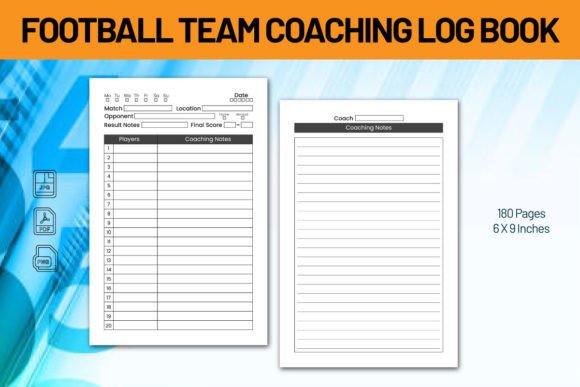
The Architect's Blueprint: Building Victory with a Football Coaching Log Book
In the dynamic world of football coaching, success is rarely a product of spontaneous inspiration. It is constructed, brick by brick, through meticulous planning, acute observation, and relentless refinement. While talent on the pitch is undeniable, the true engine of a team's progress often runs silently off the field, in the mind and methodology of the coach. For the modern coach—whether leading a youth academy side, a collegiate program, or a professional outfit—the organizational cornerstone of this methodology is a dedicated football coaching team log book.
Beyond the Notebook: A System for Sustainable Success
The term "log book" might evoke a simple diary, but its application in football coaching transcends basic note-taking. It represents a structured system for capturing the entire lifecycle of a team. From the initial vision sketched in preseason to the post-match analysis of a championship decider, every critical data point, strategic insight, and personal observation finds a purposeful home. This consolidation is vital. The cognitive load on a coach is immense; sessions, player development, tactical adjustments, opposition research, and administrative duties all compete for mental bandwidth. A practical logbook acts as an external memory, freeing the coach to engage more deeply with the immediate human and tactical elements of the role.
The Core Functions of a Coaching Log
A well-designed football coaching team log book typically serves several integrated functions. First, it is a planning hub. Here, season objectives, phased training cycles (macro, meso, and microcycles), and individual session plans are detailed. This includes drills, durations, key coaching points, and resource requirements. Second, it becomes an observation and assessment record. Notes on player performance in training and matches, progress against individual development plans, and behavioral or psychological observations are logged systematically. Third, it serves as a tactical repository. Analysis of opposition strengths and weaknesses, records of own team's tactical executions (successful or otherwise), and ideas for future strategic evolution are stored here. Finally, it can act as an administrative tracker, monitoring attendance, equipment, communications, and even personal coaching reflections.
The Tangible Advantages: From Chaos to Clarity
Implementing this tool yields profound advantages that directly translate to on-field performance and career growth. The primary benefit is the cultivation of consistency. Football is a game of patterns, and a log book helps identify them—patterns in player learning, in tactical effectiveness, in recurring errors. This data-driven approach replaces guesswork with informed decision-making.
Furthermore, it enhances communication. When discussing player progress with assistants, parents, or the players themselves, a coach can reference specific, documented observations rather than vague impressions. This builds trust and authority. For the coach's own career development, the log book is an invaluable portfolio. It provides a tangible history of one's methodologies, adaptations, and successes, useful for career advancement or sharing knowledge within the coaching community.
Perhaps most importantly, it facilitates the building and maintenance of that "unbeatable" team ethos. By tracking individual journeys within the collective framework, a coach can ensure no player is left behind. Team culture initiatives, leadership development notes, and records of group dynamics can all be nurtured through the log, helping forge a resilient and unified squad.
A Week in the Life of a Log Book
Consider a typical week. On Monday, the coach reviews the previous match's log entries: key moments, individual ratings, tactical flaws. This informs the recovery and analysis session plan logged for Tuesday. Wednesday's training focuses on correcting identified tactical issues; the session plan, with its specific coaching points, is executed and then annotated with observations on which players grasped the concepts. Thursday might see entries about a one-on-one meeting with a developing striker, noting his confidence levels and technical focus areas. Friday’s pre-match logistics and final tactical reminders are logged. After the Saturday match, the cycle begins anew with fresh, detailed analysis. This continuous loop creates a living document of the team's evolution.
Embracing the Digital Format: Flexibility and Future-Proofing
The availability of a football coaching log book as a digital download represents a significant evolution. A digital file type, such as a PDF, offers immense flexibility. Coaches can print physical copies if they prefer pen-and-paper tangibility, or they can use the files directly on tablets or laptops during sessions. The inclusion of high-resolution (180 dpi) JPG and PNG files allows for further customization; elements can be integrated into other digital presentation tools or customized notebooks. The specified dimensions of 6 inches by 9 inches suggest a format optimized for both screen viewing and standard printing, balancing portability with sufficient space for detailed entries.
The digital nature also supports easier archiving, searching, and sharing. A season's entire log can be backed up securely, and keywords within session themes or player names can be located instantly. For collaborative coaching staffs, digital logs can be shared and updated synchronously, ensuring all staff members operate from the same intelligence.
Who Stands to Benefit? The Broad Audience of Coaching
The utility of a practical logbook spans the entire spectrum of football coaching. The professional coach in a high-pressure environment needs its rigor to manage extreme complexity. The educator running a school program relies on its structure to balance teaching duties with coaching. Youth and community coaches, often juggling vast numbers of developing players, use it to provide individual attention within a group setting. Even the hobbyist coach, leading a local club, finds that it elevates their practice from a casual activity to a purposeful endeavor. Business owners operating football academies can implement standardized log systems across their coaching staff to ensure consistent methodology and quality assurance. Researchers studying coaching methods or sports pedagogy can use such logs as structured data sources for analysis.
Implementation: Making the Log Book Your Own
Adopting a new system requires a shift in habit. The key is to start simple and be consistent. Begin by logging the most critical elements: session plans and post-match analysis. Dedicate five minutes post-session and ten minutes post-match to obligatory entry. Over time, expand to include weekly player notes or tactical research. The log should not become a burdensome administrative task; its entries should be concise, actionable, and relevant. Many coaches find that the act of writing solidifies their own understanding, turning observation into insight. The log book, therefore, becomes not just a record, but a partner in the coaching thought process.
From Illustration to Reality
The concept, much like the spirit of the game from New Jersey to every corner of the globe, is about applied energy. It moves from an illustration—a template, a digital file—into the real, messy, exhilarating world of the pitch. It is there that the logged plan meets human response, the noted coaching point triggers a player's improvement, and the recorded tactical adjustment leads to a decisive victory. The football coaching team log book is the scaffold upon which these transformations are built, monitored, and repeated.
In a career dedicated to imparting knowledge, touching lives, and building successful teams, the tools we choose define our capacity. This particular tool offers a path from intuition to institution, from reactive coaching to proactive leadership. It provides a space to organize the chaos, build the strategy, and maintain the focus required to foster not just a team, but a legacy. The journey to unbeatable begins not with a whistle, but with a plan—and that plan deserves its own home.