Understanding the Self-care Planner Canva Template for Amazon KDP
For creators looking to publish a self-care journal or planner on Amazon's Kindle Direct Publishing (KDP), the process often begins with designing a professional interior. The Self-care Planner Canva Template KDP presents a specific approach to this challenge. It is not a physical planner you purchase, but rather a digital template package designed to be edited and customized using the free online design platform, Canva. The core product consists of two main components: a primary template file and an interior file, culminating in high-quality PDFs ready for upload to the KDP platform. This model represents a distinct category within the self-care publishing toolkit, sitting between fully bespoke design and pre-written, uneditable digital books.
What Distinguishes This Template Approach
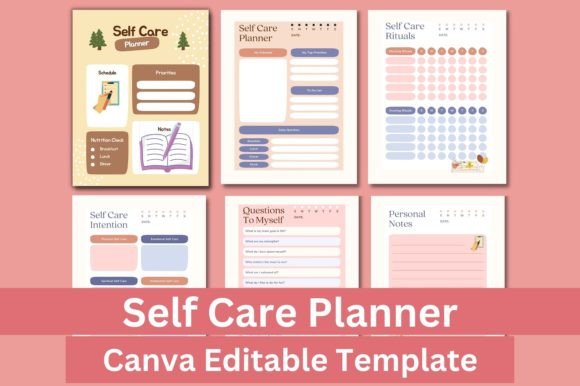
The defining characteristic of the Self-care Planner Canva Template KDP is its balance between structure and flexibility. The template provides a designed framework—121 pages with specific sections like "Belongs to," "Self Care Rituals," "Intention," "Questions To Myself," and "Personal Notes"—all formatted to Amazon KDP's print specifications of 8.5x11 inches, CMYK color, and 300 DPI with no bleed. However, because it is delivered via an editable Canva link, every element, from text to colors to layout, can be modified. This contrasts with two common alternatives: purchasing a fully finished, non-editable PDF interior where you can only change the cover, or hiring a graphic designer for a completely custom project from scratch.
The provided checklist highlights its practical construction. It is tested on Amazon KDP, which suggests the creator has verified the technical compliance, reducing a common hurdle for new publishers. The inclusion of both a high-quality PDF and the editable source link addresses two key user needs: a guaranteed final output and the ability to personalize. This dual offering is a significant tradeoff consideration. The structure saves immense time and ensures technical correctness, but your final product is inherently shaped by the template's initial design philosophy and page sequence.
Comparing Template-Based Publishing to Other Routes
When evaluating how to create a self-care planner for KDP, several paths exist, each with different strengths and commitments.
Full Custom Design
Hiring a designer or learning advanced software like Adobe InDesign offers maximum originality. You control every aesthetic and functional detail, tailoring the planner to a very niche audience or a unique therapeutic framework. The tradeoffs are substantial: higher cost, significant time investment, and the need to manage all technical specs yourself. The Self-care Planner Canva Template KDP is an alternative that drastically reduces these barriers. It provides a professional baseline, but your customization is confined within Canva's capabilities and the template's existing module arrangement. For someone with a highly specific vision that doesn't align with the included sections like "Self Care Rituals" or "Questions To Myself," this template may require extensive rework or not be the right fit.
Pre-made, Non-editable Interiors
Many marketplaces sell ready-to-upload PDF interiors. These are the fastest option; you simply add your cover and upload. They are often inexpensive and guarantee KDP compliance. The limitation is absolute: you cannot alter the content, fonts, or layout to match your brand or adapt the planner's focus. If your goal is to publish quickly under a generic title, this might suffice. The Self-care Planner Canva Template KDP, however, targets creators who want a faster start than custom design but still require personalization—perhaps to align with a specific coaching method, to use a unique color palette for their brand, or to slightly rephrase the prompted questions.
Building from Scratch in Canva
Starting with a blank Canva document gives you the same editing freedom as the template but without the pre-built structure. This demands a strong design sense and time to create 121 pages that are visually consistent and functionally logical. The template's value here is as a foundational accelerator. It solves the problem of page layout, section ideation, and overall cohesion. You trade some original layout creativity for a robust, tested starting point that you can then tweak. For a creator competent in Canva but lacking time or confidence in full interior design, this is a compelling middle-ground.
Evaluating Fit and Use Cases
Determining if this product is the right choice depends heavily on your profile as a creator and your goals for the planner.
Best-Fit Situations for the Self-care Planner Canva Template
This template approach is particularly well-suited for several scenarios. First, for coaches, counselors, or wellness influencers who want to offer a branded physical product to their clients or community without investing in bespoke design. The editable link allows them to insert their logo, use their signature colors, and modify prompts to reflect their specific methodology. Second, for aspiring KDP publishers who have content expertise in self-care but lack graphic design skills or software. The template provides a professional "shell" they can fill with their knowledge. Third, for entrepreneurs testing the market with a self-care planner. The relatively low cost and effort compared to custom design allow for a viable product launch to gauge demand.
The emphasis on easy editing via a free Canva account also makes it a strong fit for those wary of subscription software costs. Canva's intuitive interface lowers the technical barrier further.
When Another Option Might Be Necessary
Limitations exist. If your envisioned planner requires a radically different format—such as a daily undated calendar, a heavy focus on tracking specific health metrics, or an intensive guided journal with deeply narrative prompts—the template's predefined sections may be too constraining. Extensive modification could become so laborious that starting from scratch becomes more efficient. Similarly, if your target audience expects extreme aesthetic luxury or a unique size (like 6x9 inches), this 8.5x11 template, even when edited, may not meet that expectation. The note about "No Bleed" also indicates it's designed for interiors without full-cover color or images, which is a design limitation some creators might seek.
Furthermore, while Canva is powerful, its typography and layout control are not as granular as professional desktop software. For designers seeking precise typographic hierarchy or complex vector illustrations within the planner, the template's Canva-based nature could be a limitation.
Key Decision Factors for Creators
When comparing this to other resources, consider these practical factors:
- Time vs. Originality: The template saves weeks of design time but accepts the template's core structure as your starting point. How important is total originality to your project?
- Technical Assurance: The product is "tested on Amazon KDP." This resolved technical headache is a major benefit compared to going fully custom, where you must validate all specifications.
- Customization Depth: Assess if Canva's editing tools are sufficient for the changes you envision. Can you achieve your desired look and content flow within this framework?
- Page Count and Structure: 121 pages with the listed sections provide a substantial, structured planner. Does this length and this specific sequence of sections (rituals, intentions, questions, notes) align with your content plan?
- Economic Model: As a template, it's typically a one-time purchase. Compare this cost to hiring a designer or the recurring subscription of professional design software.
The Importance of the Integrated Checklist and Sections
The included checklist—Belongs to page, Self Care Rituals, Self Care Intention, Questions To Myself, Personal Notes—is more than a feature list; it reveals the template's philosophical approach to self-care. It frames self-care as a holistic practice involving ownership ("Belongs to"), habitual actions ("Rituals"), mindful focus ("Intention"), introspection ("Questions"), and free-form reflection ("Notes"). A creator should evaluate whether this framework matches their intended message. If you aim to create a planner focused solely on, say, fitness tracking or financial mindfulness, these sections might need significant alteration, which is possible but constitutes work.
Ultimately, the Self-care Planner Canva Template KDP occupies a valuable niche. It is a tool for informed creators who understand that a ready-made, editable template offers a pragmatic compromise between speed, cost, control, and professionalism. It is not the solution for every self-care publishing project, but for those whose vision aligns reasonably with its structure and who value the ability to personalize within a guided framework, it represents a efficient and practical path to producing a market-ready product.