Alphabet Number Color Cut and Paste for Creative Professionals
At first glance, Alphabet Number Color Cut and Paste might seem like a classic children's activity. But for creators, educators, and entrepreneurs, it represents something far more valuable: a versatile, foundational creative template. The core idea is simple—activities where learners identify, color, cut out, and paste letters and numbers—but its utility extends well beyond the classroom. This template is a powerful starting point for anyone building educational content, developing fine motor skill resources, or creating engaging printable products.
The Foundational Appeal of a Multisensory Template
What makes this particular activity format so interesting is its built-in multisensory approach. It combines visual recognition (identifying letters and numbers), artistic expression (coloring), physical dexterity (cutting), and spatial reasoning (pasting). This layered process is not only effective for early learning but also serves as a proven framework for skill development. For an adult creator, this means you are working with a structure that is already pedagogically sound and inherently engaging. The “fun” factor is already baked in, which is a significant advantage when designing products meant to capture attention and facilitate learning.
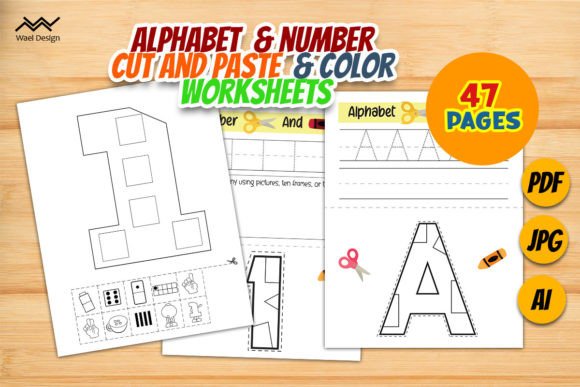
The provided template, with its 47 ready-made pages, offers immediate utility. It removes the heavy lifting of designing each individual activity from scratch. You receive a complete set in multiple formats—Adobe Illustrator for customization, JPG for quick use, and a print-ready PDF—giving you flexibility. Whether you are a graphic designer wanting to tweak the style in Illustrator, a blogger needing to embed images in a post, or a publisher preparing a workbook for sale, the assets are adaptable to your workflow.
Creative Applications Beyond the Basic Worksheet
The true potential lies in how you interpret and adapt this core material. It’s not just a set of worksheets; it’s a creative component you can integrate into larger projects or re-style for different audiences.
For Educators and Specialist Tutors
Teachers and tutors can use these activities directly as supplementary material for literacy and numeracy lessons. However, the creative expansion might involve sequencing the pages to follow a specific curriculum, combining them with storytelling (paste the letter ‘B’ onto the bear’s picture), or even translating the instructions into another language for bilingual education. The 300 DPI resolution ensures crisp prints for handouts, even if the child is coloring with fine-tipped markers.
For Content Creators and Bloggers
A blogger focused on parenting, early education, or occupational therapy ideas can use these pages as premium downloadable content for their audience. They might write articles that explore the fine motor skill benefits of such activities, offering the JPG images as a free resource to build email lists. The pages can be broken down into smaller pieces for social media posts, showcasing a “daily activity idea” to drive traffic.
For Low-Content Book Publishers and Entrepreneurs
This is where the template shines for business. The 8.5 x 11 inch American letter size is the standard for a vast market of printable books and workbooks. You can add your own cover, compile the PDF, and upload it to platforms like Amazon KDP or Etsy as a complete product. The “no problem with the font” aspect is crucial—it means your final product will print reliably without licensing issues. Furthermore, you can use the Illustrator file to create variations: perhaps a minimalist black-and-white version for cost-effective printing, or a themed version where the background scenes change (ocean alphabet, space numbers).
Adapting the Template for Different Audiences and Goals
The uniform structure of the activities allows for easy adaptation to suit different age groups or learning objectives. For a younger audience, you might emphasize the coloring and pasting elements, using larger cut-out areas. For older children or those needing extra challenge, you could modify the template in Illustrator to include more complex sequences or pattern-based coloring.
Consider also non-educational applications. Artists might see these pages as a basis for mixed-media collage projects, using the numbered and lettered shapes as elements in a larger artwork. Occupational therapists could use the precise cutting and placing tasks as measured exercises for hand-eye coordination rehabilitation, adjusting the difficulty by varying the size and shape of the pieces to be cut.
The key to effective adaptation is maintaining the clarity of the original activity while aligning it with your new goal. Keep the instructions simple and the layout clean. If you are targeting adults for a therapeutic or artistic purpose, you might change the instructional language from “learn your letters” to “focus, cut, and arrange.” Consistency in style across your adapted pages—using a coherent color palette, graphic style, and font if you add text—will make the final product feel professional and intentional.
Building a Cohesive Product Line
For entrepreneurs, this single template can be the seed for a whole product line. From the core Alphabet Number Color Cut and Paste pack, you could develop:
- Seasonal Editions: Halloween-themed letters, Christmas number pages.
- Skill-Specific Sets: A “Cutting Practice Only” set, or a “Color and Match” variation.
- Bundled Resources: Combine this template with other printables, like tracing sheets or flash cards, to create a comprehensive early learning bundle.
Using the provided Illustrator AI file allows for this kind of brand consistency. You can alter colors and graphics while keeping the underlying activity layout, enabling you to produce a series of products that look like part of a family.
Practical Recommendations for Implementation
Start by assessing your primary format. If you are selling physical books, the print-ready 300 DPI PDF is your foundation. Ensure your added cover matches the dimensions and resolution. For digital sales, you might provide the PDF alongside the individual JPGs as a “clip art” pack, giving customers more flexibility.
When customizing, avoid overcomplicating the page. The activity’s effectiveness relies on its clear, focused task. If you add too many decorative elements or instructions, the core objective—letter/number recognition and fine motor practice—can get lost. Test your adapted pages by printing them. Check that the cutting lines are clear and the pasting targets are appropriately sized.
Finally, consider your audience's end-use. If they are parents printing at home, remind them of the paper weight and scissors suitable for the task. If they are therapists, they might need guidance on repetition and progression. Providing brief, practical notes alongside your product can greatly enhance its perceived value and usefulness.
The Alphabet Number Color Cut and Paste template is more than a collection of pages; it’s a flexible tool for creative professional projects. It bridges the gap between educational theory and practical content creation, offering a ready-made structure that you can own, customize, and deploy in multiple contexts. By understanding its core strengths and thoughtfully adapting it, you can create original, effective resources that serve your specific audience and goals.